
Co-founder matching
Find Technical Co Founder: Sourcing & Vetting Guide
Short answer
To find a technical co-founder, first validate market demand by talking to real customers and securing early traction, like waitlists or letters of intent. Next, leverage structured matching environments, such as accelerator programs like Y Combinator's Startup School, or attend regional networking events like Founder Finder meetups in cities like Chicago and Indianapolis. Attracting top engineering partners is crucial, as Antler's 2025 study found that 90% of European unicorn founders since 2022 possessed technical backgrounds.

Finding a technical partner requires demonstrating market pull rather than pitching unvalidated concepts. Technical builders frequently evaluate commercial operators on their ability to uncover genuine demand, eliminate speculative requirements, and establish sound product governance. Securing a dedicated technical co-founder depends on proving that the commercial foundation is already viable before initiating a search.
Channels and Programs for Connecting with Potential Technical Co-Founders#
Entrepreneurs seeking to find a technical co founder can leverage regional events, focused online communities, and accelerator ecosystems. In-person engagement allows commercial leaders to present clear role expectations directly to engineers. Regional founder networking events, such as Founder Finder meetups, rotate through Midwestern cities including Chicago, Indianapolis, Madison, and Milwaukee (crv.com). These gatherings offer a venue to evaluate potential partners through immediate problem-solving discussions rather than cold digital outreach.
Online discussion platforms provide direct access to engineers discussing architecture, open-source work, and system design. Technical candidates actively participate in Hacker News, Reddit communities like r/startups, and specialized Discord or Slack groups (crv.com). Consistent, substantive engagement in these forums builds professional credibility over time. In addition, startup accelerators like Y Combinator's Startup School provide structured cohort environments that act as natural matching grounds for co-founders. The shared intensity and deadlines of cohort programs help participants observe work habits under genuine delivery pressure.
| Channel Category | Primary Venues | Engagement Dynamic |
|---|---|---|
| Regional Meetups | Founder Finder meetups (Chicago, Indianapolis, Madison, Milwaukee) (crv.com) | In-person technical discussions and rapid qualification |
| Online Communities | Hacker News, r/startups, targeted Slack/Discord groups (crv.com) | Asynchronous technical debate and project evaluation |
| Accelerator Programs | Y Combinator's Startup School (crv.com) | High-pressure cohort collaboration and structured matching |
Early Customer Validation and Traction Evidence Before Recruiting#

Commercial founders must secure concrete market signals before attempting to recruit engineering leadership. Before beginning a search for a technical co-founder, founders can validate the market by talking to real customers, documenting their needs, and generating modest traction such as paying customers, a growing waitlist, or letters of intent (crv.com). Technical operators routinely reject pitches that rely purely on slide decks, wireframes, or unsubstantiated projections. Presenting raw interview transcripts alongside documented problem frequencies demonstrates that customer discovery has occurred.
Documented commercial traction transforms recruiting conversations into collaborative execution planning. When a founder presents verified commitments or customer deposits, prospective engineers see a de-risked venture that warrants their time. That concrete demand evidence simplifies subsequent equity conversations (crv.com). Furthermore, establishing clear customer pain points prevents the engineering team from wasting development cycles on speculative, undifferentiated product plumbing.
Technical Background Trends Among Venture-Backed Unicorn Founders#
The composition of founding teams in venture-backed software businesses has shifted substantially toward engineering capabilities. Antler reported that European unicorn founders with technical profiles rose to 90% since 2022 from 26% prior to 2020.
European unicorn founders with technical backgrounds
| Period | Share of founders |
|---|---|
| Pre-2020 | 26% |
| Post-2022 | 90% |
The rise in technical founder representation highlights an evolving product delivery environment. Modern software development mandates that leadership teams understand complex architecture, hosting infrastructure, and deployment pipelines to operate efficiently. When commercial leaders seek an engineering partner, they must recognize that modern product organizations prioritize rapid architectural iteration over administrative hierarchy.
Assessing Working Compatibility Through Structured Trial Projects#
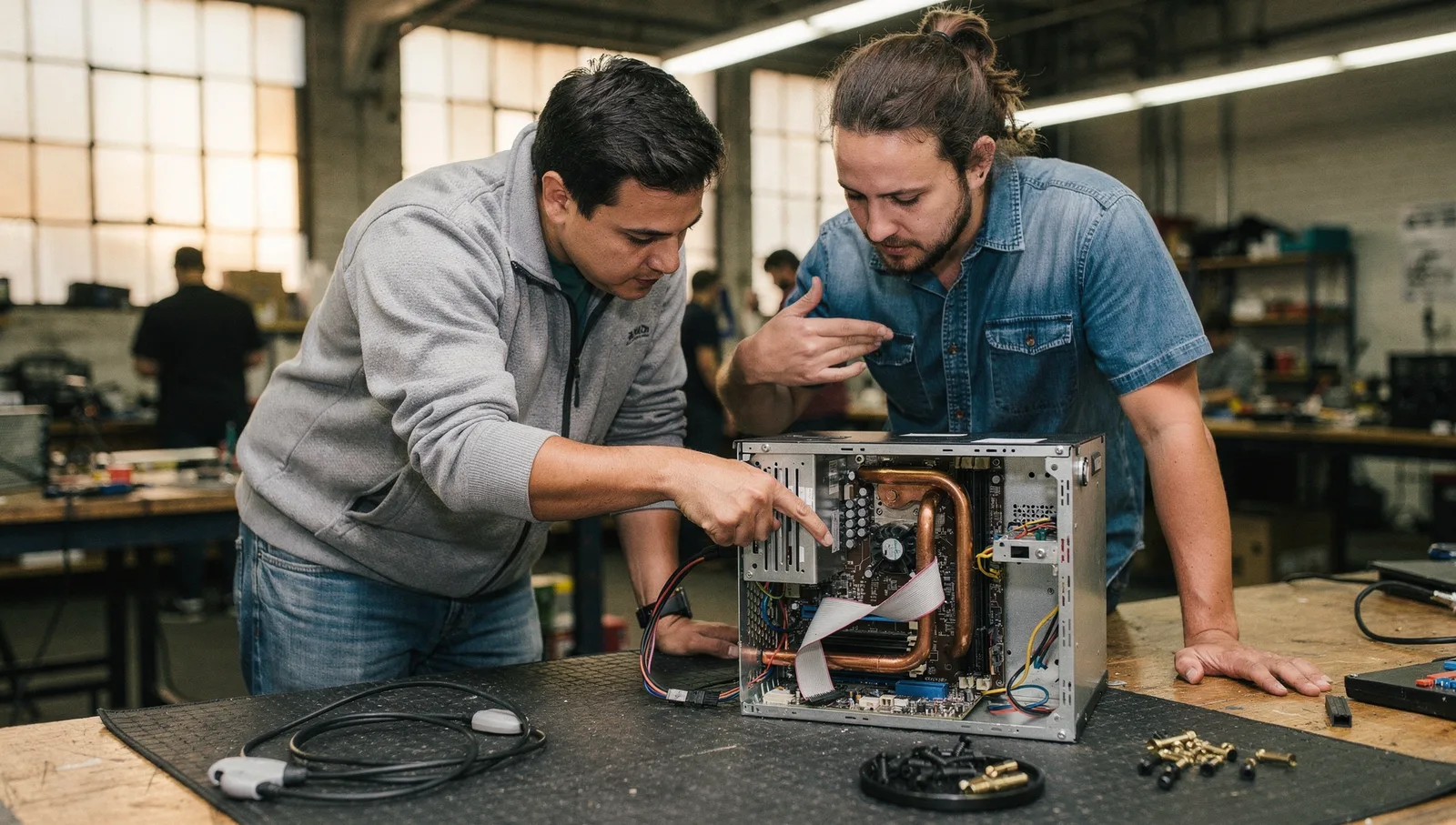
Founders can evaluate working dynamics by executing a scoped, 30-to-90-day pre-equity collaboration project. Rather than assigning equity immediately upon an initial agreement; the team should build a focused proof of concept or minimum viable product (MVP), defined as an initial product iteration containing the core functionality necessary to validate customer hypotheses. This trial period surfaces how both parties navigate scope negotiations, schedule pressure, and unexpected production bottlenecks.
A technical due diligence checklist during this trial should focus on code maintainability and foundational software decisions:
- Review code repository commits to observe branch management, automated test coverage, and documentation habits.
- Inspect system architecture choices to determine whether the engineer avoids accumulating unmanaged technical debt, which refers to future refactoring costs caused by choosing expedient shortcuts over sound architectural design.
- Verify whether the engineer implements day-one operational guardrails, including logging, automated builds, and deployment rollbacks.
- Evaluate the candidate's willingness to build a lightweight proof of concept rather than over-engineering infrastructure before customer feedback arrives.
When an early-stage startup cannot immediately attract a full-time engineering partner, founders can consider alternatives such as engaging a fractional Chief Technology Officer (CTO) or partnering with a boutique development firm. Establishing clear delivery milestones during an agency or fractional arrangement can create a natural transition pathway into a permanent co-founder relationship once customer traction accelerates.
Structuring Equity Allocation, Vesting Schedules, and Governance Roles#
Long-term venture alignment requires formal agreements governing ownership, intellectual property, and strategic oversight. Co-founders must implement a formal vesting schedule, which represents a contractual timetable specifying when granted equity legally transfers to an individual. A standard startup agreement enforces a multi-year vesting term paired with a one-year cliff period, defined as a minimum service threshold that must elapse before any equity ownership vests. If a partner leaves the venture during the cliff period, they forfeit unvested shares, protecting the company cap table from departed contributors.
Founders must establish clean legal documentation from day one by executing an IP assignment agreement, which transfers all proprietary code, trade secrets, and system architecture rights from individual creators directly to the corporate entity. Clean governance also requires defining operational titles and operational hierarchy. While a Chief Executive Officer (CEO) holds statutory management authority over strategic decisions, a technical co-founder oversees technical architecture and engineering execution.
Evaluating Your Next Operational Move#
Evaluating potential technical leadership requires disciplined operational auditing rather than relying on informal rapport. Before formalizing agreements, execute the following audit checklist:
- Confirm customer demand through documented market evidence such as waitlists or letters of intent, detailed in the validation section above.
- Structure a scoped pre-equity trial project to assess working compatibility and proof-of-concept delivery, as outlined in the trial project section above.
- Conduct a thorough code repository evaluation during the trial to assess modular architecture and test practices.
- Finalize equity allocation models that integrate one-year cliff vesting schedules and IP assignment protections, covered in the governance section above.
| Sourcing Channel | Channel Format | Geographic or Community Scope | Candidate Evaluation Dynamic |
|---|---|---|---|
| Regional Meetups | In-person networking events | Midwestern cities (Chicago, Indianapolis, Madison, Milwaukee) | Real-time problem solving, 30-second pitches, and immediate qualification |
| Online Communities | Asynchronous discussion forums | Global (Hacker News, r/startups, targeted Slack/Discord groups) | Technical architecture debate, substantive discussion, and curiosity |
| Accelerator Cohorts | Structured incubator programs | Program cohorts (e.g., Y Combinator's Startup School) | High-pressure cohort collaboration and shared deadline execution |
| Founder Group | Era | Technical Background Share |
|---|---|---|
| European Unicorn Founders | Prior to 2020 | 26% |
| European Unicorn Founders | Since 2022 | 90% |
| United States Unicorn Founders | Since 2022 | 80% |
Technical Co-Founder Equity Allocation & Vesting Calculator
Helps early-stage commercial founders evaluate fair equity splits and vesting schedules when partnering with a technical co-founder based on initial commitment, capital contributions, and standard vesting cliffs.
Total Allocated Equity Pool:
Recommended Technical Co-Founder Equity:
Recommended Commercial Co-Founder Equity:
Technical Co-Founder Equity Vested at Cliff:
Technical Co-Founder Monthly Vesting Rate:
Frequently Asked Questions
What is a technical co-founder?
A technical co-founder is an early-stage startup partner who oversees technical architecture, engineering execution, and software development, while holding equity and co-founding status in the enterprise.
Who is higher, CEO or CO-founder?
The CEO holds formal statutory management authority over strategic corporate decisions, whereas a technical co-founder directs technical architecture and engineering delivery within the operational hierarchy.
How to find startup co-founder?
Entrepreneurs can find a potential technical co-founder by leveraging regional events, focused online communities, and accelerator ecosystems. In-person venues include regional founder networking meetups like Founder Finder, while digital options include Hacker News, Reddit communities such as r/startups, and specialized Slack or Discord groups. Structured cohorts like Y Combinator's Startup School also serve as matching environments. Before beginning the search, founders should establish commercial traction and validate the market with real customer data, waitlists, or letters of intent.
Sources
- Technical Founder Startup Statistics | STARTUP RESEARCH - blog.mean.ceo (2026-06-04)
- CRV | How to Find a Technical Cofounder for Your Startup - crv.com